4 Types of Solar Cookers: Box, Parabolic, Panel, and Indirect

Cooking with sunlight is one of those ideas that sounds almost too simple to be practical until you watch a pot of rice come to a full boil on a clear afternoon with no flame, no gas cylinder, and no electricity bill attached to the meal. Solar cookers have been doing exactly this for decades in Indian villages, disaster relief camps, remote mountain communities, and increasingly in urban homes where environmental awareness meets rising fuel costs.
But solar cooking is not a single technology. There are four distinct types of solar cookers, each capturing and using sunlight in a genuinely different way, each producing different cooking temperatures and speeds and suited to different uses. Knowing the difference between them is the first step toward understanding which one actually fits your household, your cooking habits, and your climate.
Here is a clear look at all four.
First, the Common Thread
Before getting into the differences, here is what every solar cooker shares. All four types use sunlight as their only heat source. All of them work on the same underlying principle: concentrate or trap solar radiation to generate enough heat to cook food. None of them produce smoke, consume fuel, or emit carbon during operation. And all of them require direct sunlight to function, which means cloud cover, haze, and positioning relative to the sun matter for every type, even if each handles those factors slightly differently.
They vary in sunlight capture, heat output, cooking speed, and cooking methods.
1. Box Solar Cooker: The Slow and Steady Household Workhorse
The box solar cooker is the most widely used and most recognizable type in India, and the design is exactly what the name suggests. An insulated box, typically with a dark interior to absorb heat and a glass or transparent cover on top that lets sunlight in while trapping warmth inside, is essentially a miniature greenhouse built specifically for cooking.
Reflective panels, usually one or more hinged mirrors attached to the lid or sides, redirect additional sunlight into the box to boost the temperature inside. Food is placed in dark-colored pots or trays inside the box, which absorb and retain heat, and the sealed glass cover prevents that heat from escaping.
Box cookers reach cooking temperatures typically ranging from 100 to 150 degrees Celsius on a clear day, sufficient to boil water, cook rice, dal, vegetables, and most staple Indian foods thoroughly, though they do so more slowly than a gas flame. A meal that takes 20 minutes on a stove might take 60 to 90 minutes in a box cooker, which is less a flaw than a design characteristic to plan around.
The real strengths of a box cooker are safety, simplicity, and the ability to cook without supervision. Because temperatures stay moderate and heat is enclosed rather than directed outward, the risk of burning food is low, and a box cooker can be left to cook unattended while the sunlight does its work. This makes it well suited to slow-cooked dishes, grains, legumes, and anything that benefits from gentle, sustained heat rather than a quick high-temperature blast.
Box solar cookers are also the most affordable type, widely manufactured in India, and available from government-supported programs and commercial suppliers alike. The Bureau of Indian Standards maintains IS 13429 as the relevant certification standard for solar cookers in India, and BIS-certified box cookers from established manufacturers are the most reliable starting point for first-time buyers.
Suits: Household daily cooking of grains, lentils, and vegetables; slow-cooked dishes; unattended cooking; buyers wanting the most affordable, maintenance-free solar cooking option.
2. Parabolic Solar Cooker: The High-Heat Performer
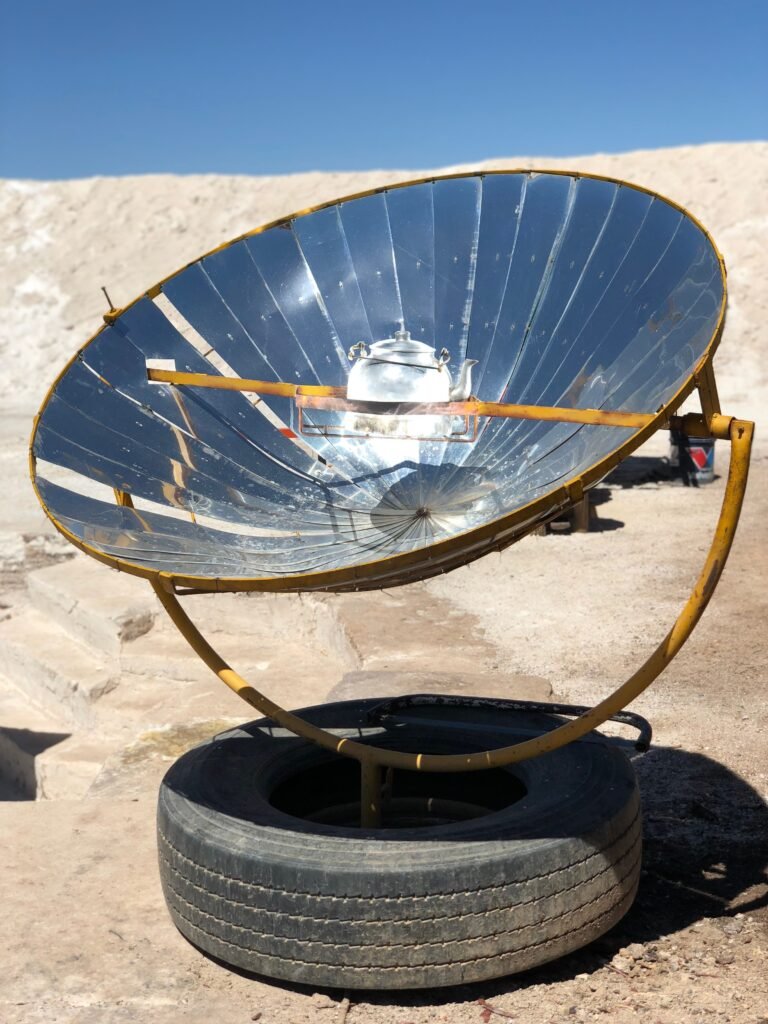
If the box cooker is the slow, reliable pressure cooker of the solar world, the parabolic cooker is the open flame. Parabolic solar cookers use a large, curved dish, shaped like the inside of a bowl or satellite dish, with a highly reflective surface that concentrates all incoming sunlight onto a single focal point directly above or below the dish’s center. A cooking pot placed at that focal point receives an intensely concentrated beam of solar energy.
The result is cooking temperatures that can reach 200 to 300 degrees Celsius or higher at the focal point, sufficient for frying, stir-frying, grilling, boiling water rapidly, and cooking at speeds approaching or matching a conventional gas stove. A parabolic cooker can bring a liter of water to boiling in 10 to 15 minutes on a clear day, a speed that no box cooker or panel cooker can match.
This high performance comes with meaningful tradeoffs. Parabolic cookers require frequent manual adjustment, since the dish must be repositioned to track the sun as it moves across the sky, typically every 10 to 20 minutes during cooking. They also direct highly concentrated light at a single point, which means the area around the focal point gets extremely hot and the reflected light is intense enough to cause eye damage if viewed directly without protection. Cooking on a parabolic requires more active attention than a box cooker, and leaving food unattended for extended periods risks burning.
Size is another consideration. Parabolic cookers large enough to generate useful cooking heat typically have dish diameters ranging from one to several meters, which makes them less suited to small urban rooftops or balconies than to larger outdoor spaces, community kitchens, or institutional settings.
Suits: Outdoor cooking requiring speed or high heat, frying and stir-frying, community or institutional solar kitchens, and buyers with large outdoor spaces who cook actively rather than unattended.
3. Panel Solar Cooker: The Lightweight Portable Option
Panel cookers sit between box and parabolic designs in terms of complexity and performance. Rather than an enclosed insulated box or a large curved dish, a panel cooker uses flat or slightly curved reflective panels arranged around a central cooking area to direct sunlight onto a pot, which is typically placed inside a clear plastic or glass bag or enclosure to trap some of the heat.
The transparent enclosure around the pot is what distinguishes panel cookers from a simple arrangement of mirrors. It acts as a miniature greenhouse for the pot itself, trapping hot air immediately around the cooking vessel and meaningfully boosting the temperature achieved compared to directing sunlight at an uncovered pot.
Panel cookers are generally the most portable and lightweight of the four types, since they use simple flat reflective surfaces, often made from cardboard covered with reflective material or thin aluminum sheets, rather than heavy insulated boxes or large rigid dishes. This portability makes them popular for camping, outdoor events, emergency preparedness kits, and low-cost solar cooking programs in rural areas.
Cooking temperatures achieved by panel cookers are typically lower than both parabolic and well-designed box cookers, generally reaching around 100 to 130 degrees Celsius in good conditions, and they are more sensitive to wind and partial cloud cover than a well-insulated box design. However, their extremely low cost and simple construction make them the easiest type to build at home from basic materials, and several DIY panel cooker designs are widely documented and used in solar cooking communities.
Suits: Camping and outdoor use, portability-focused applications, low-cost or DIY solar cooking, emergency preparedness, and slow cooking of simple foods in favorable weather conditions.
4. Indirect or Heat Storage Solar Cooker: The Cooking-After-Dark Option
The indirect solar cooker, sometimes called a heat storage solar cooker or a solar thermal cooker, addresses the single biggest limitation of all three types above: they can only cook while the sun is shining. An indirect cooker separates the heat collection and the cooking into two distinct stages, using a phase-change material or a heat-storing medium to capture and hold solar energy during the day so that cooking can happen later, in the evening, at night, or during a brief cloudy spell when the other types would simply stop working.
In the most common design, solar energy heats a thermal storage medium, often a high-temperature phase-change material such as an erythritol-based compound or another material that absorbs and stores large amounts of heat energy at a specific temperature, during daylight hours. When cooking is needed, the stored heat is transferred to the cooking vessel through a heat exchanger, providing a sustained, controllable heat source that does not depend on the sun being overhead at that moment.
This technology is more complex, heavier, and pricier than the other three types and is less common in residential settings in India, though research institutions including the National Institute for Interdisciplinary Science and Technology and various IITs have developed and promoted designs specifically suited to Indian cooking practices. For households where evening cooking is non-negotiable and solar cooking is still a priority, indirect cookers offer the only solar-powered path to cooking after sunset.
Suits: Households that cook primarily in the evening, institutions that want solar cooking but cannot adjust meal timing around peak sunlight hours, and research and demonstration programs.
| A Quick Comparison at a Glance | |||||
|---|---|---|---|---|---|
| Type | Temperature Range | Cooking Speed | Portability | Sunlight Dependency | Best Use |
| Box | 100-150°C | Slow | Low | Direct sun only | Grains, dal, unattended cooking |
| Parabolic | 200-300°C+ | Fast | Low (large size) | Direct sun, frequent tracking | Frying, boiling fast, high heat |
| Panel | 100-130°C | Slow-moderate | High | Direct sun only | Camping, portability, DIY |
| Indirect | 100-150°C (stored) | Moderate | Low | Charges in sun, cooks later | Evening cooking, flexible timing |
Frequently Asked Questions
Q1: Which type of solar cooker is best for everyday household cooking in India?
For most Indian households cooking dal, rice, and vegetables, a BIS-certified box solar cooker is the most practical starting point. It is affordable, widely available, requires no active supervision during cooking, and handles the staple cooking needs of a typical family well on clear days.
Q2: Can a solar cooker really reach temperatures high enough to fry food?
Yes, but only parabolic solar cookers achieve the 200 degrees Celsius or higher temperatures needed for frying. Box and panel cookers top out well below frying temperatures and are suited to boiling, steaming, and baking rather than high-heat frying.
Q3: Do solar cookers work during the monsoon or on cloudy days?
All four types require direct sunlight to generate meaningful cooking heat. On heavily overcast days or during sustained monsoon cloud cover, solar cookers are not functional. The indirect type can cook using stored heat from a previous sunny period, but even it requires adequate sunlight during the charging phase. Most solar cooking households use solar cookers during clear periods and maintain a conventional backup for cloudy days.
Q4: Is there a BIS or government standard for solar cookers in India?
Yes. The Bureau of Indian Standards has established IS 13429 as the relevant standard for solar box cookers in India. BIS-certified solar cookers have been tested to minimum performance criteria, making certification a useful quality signal when comparing products from different manufacturers.
Q5: Can I build a solar cooker at home?
Panel cookers specifically are well suited to home construction using basic materials, including cardboard, aluminum foil, and a clear plastic bag or sheet. Box cookers can also be built at home with moderate DIY skill, and numerous documented designs exist specifically for Indian conditions and cooking practices. Parabolic and indirect types are generally more complex and are better purchased from manufacturers than built at home.
Four types, four different approaches to the same task: turning sunlight into a meal. The right one for any given household depends on what gets cooked, when it gets cooked, how much space is available, and how much active attention the cook is willing to give the process. But in a country with as much sunlight as India receives across most of the year, any one of these four types represents a genuine, practical path to cooking that costs nothing to fuel once installed.

My work focuses on finding the human stories behind the headlines, from documenting unique cultural traditions to covering stories from communities across Bengal. Previously, I worked as an SEO Content Writer with Penning Down and Collegedunia, combining digital content expertise with newsroom journalism.
I believe impactful journalism is built on accuracy, empathy, and stories that stay with readers.
- Cocoa Butter Formula, Body Massage Lotion for Stretch Marks - April 9, 2016
- Ultra-calming makeup removing wipes - April 9, 2016
- Eczema therapy hand cream - April 9, 2016
Blog Insights
View All CouponTalk Blogs
12 Best LED Lighting Brands In India

10 Best Water Pump Brands In India
10 Best RO Membrane Brands In India
10 Best Electric Wire Brands In India
10 Best Electric Pressure Cooker Brands In India

10 Best Air Fryer Brands In India