Types of Solar Panels in India: Region-Specific Buying Guide

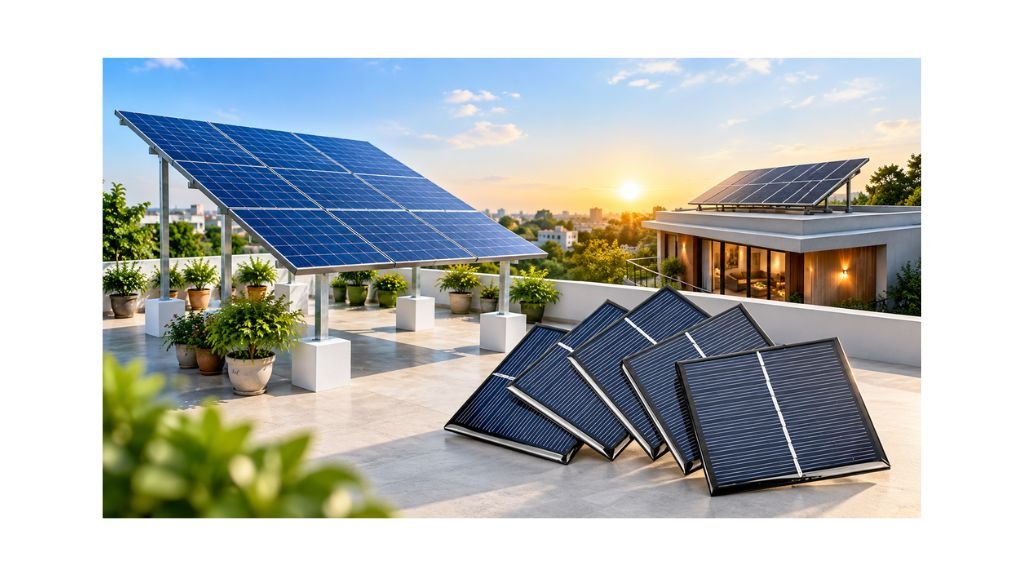
Two neighbors in Jaipur go solar in the same month. One installs monocrystalline panels on the advice of a local dealer. The other goes with a cheaper polycrystalline set he found on a distributor’s website. Six months later, the first neighbor’s system is producing close to what the installer promised. The second neighbor’s is not, and he cannot quite figure out why.
The panels are not defective. The installation is not wrong. The problem is simpler than that. Polycrystalline panels lose efficiency faster under high temperatures, and Jaipur in May is not kind to temperature-sensitive equipment. The first neighbor paid more and got output closer to the spec sheet. The second neighbor saved money upfront and is now quietly losing it on the electricity bill every month.
This is the conversation most solar buying guides skip. Not which panel has the highest efficiency rating in a lab in Germany, but which panel type actually makes sense for the weather, the roof, and the electricity bill in the place where you actually live in India.
First, a Word About How Indian Climates Divide the Country
Before getting into panel types, it helps to think about India not as one solar market but as several distinct ones layered across the same map.
The northwest, covering Rajasthan, Gujarat, and parts of Madhya Pradesh, gets the most sunshine hours in the country but also some of the most extreme heat. Panels here face both the best raw solar resource and the biggest temperature efficiency penalty.
The south, covering Tamil Nadu, Andhra Pradesh, Telangana, and Karnataka, sits in a high irradiance zone but deals with high humidity for much of the year, which affects panel surface degradation over time.
The western coast and the northeast get shorter sunshine windows, significant cloud cover during monsoon months, and, in the northeast’s case, some of the lowest annual irradiance in the country.
The Indo-Gangetic plain, covering UP, Bihar, Delhi, and parts of Haryana, sits somewhere in the middle on most metrics but has the added challenge of heavy dust and smog, which affects how much light actually reaches the panel surface on any given day.
Each of these zones asks slightly different things from a solar panel, and that is where the choice between panel types starts to matter.
The Three Main Types of Solar Panels Available in India
1. Monocrystalline Panels
Monocrystalline panels are made from a single continuous crystal of silicon, which gives them a uniform dark appearance and the highest efficiency of the three types. They convert more sunlight into electricity per square metre than anything else available in the residential solar market, which matters on roofs where space is limited.
They also handle high temperatures better than polycrystalline panels, though no silicon panel is immune to heat loss entirely. The general rule is that solar panel output drops as panel temperature rises above 25 degrees Celsius, and monocrystalline panels lose a smaller percentage per degree than polycrystalline ones do.
The catch is price. Monocrystalline panels cost more than polycrystalline panels at every watt rating, and the premium can add up to a significant difference on a full rooftop system.
Best regions for monocrystalline panels: Rajasthan, Gujarat, and parts of Madhya Pradesh, where extreme heat makes the better temperature coefficient worth paying for. Also, the right choice for any roof in any region where available space is genuinely limited, since the higher efficiency means more output per square metre of roof used.
2. Polycrystalline Panels
Polycrystalline panels are made from multiple silicon fragments melted together, which gives them that recognisable blue, slightly speckled appearance. They are less efficient than monocrystalline panels at the cell level, typically by three to five percentage points, and they lose more efficiency per degree of temperature rise.
What they have going for them is cost. A polycrystalline system costs meaningfully less than a monocrystalline one at the same kilowatt capacity. In regions where temperatures stay moderate, and rooftop space is not a constraint, the efficiency gap matters less in practice than it does on a spec sheet.
They are also widely available. The supply chain for polycrystalline panels in India is deep, with multiple domestic manufacturers producing them, which means better pricing and easier replacement sourcing compared to premium monocrystalline panels from overseas manufacturers.
Best regions for polycrystalline panels: The Indo-Gangetic plain covering Delhi, UP, Bihar, and Haryana, where temperatures are high but not extreme, and roof space on most houses is generous enough to accommodate slightly less efficient panels. Also reasonable in parts of Maharashtra and Karnataka, where temperatures are more moderate than in the deep northwest.
3. Thin Film Panels
Thin film panels are made by depositing photovoltaic material onto a substrate like glass, metal, or plastic, which makes them lighter and more flexible than crystalline silicon panels. The most common variety in India is cadmium telluride, though amorphous silicon thin film panels also exist.
Thin film panels have the lowest efficiency of the three types in standard conditions, but hold a specific advantage that the other two do not: they perform better in low-light and diffuse-light conditions. On cloudy days and during the monsoon months when the sky is bright but overcast rather than clear, thin film panels produce proportionally more than their crystalline counterparts.
They are rarely the right choice for a standard residential rooftop where space is limited, and peak output is the goal. But for large flat commercial rooftops, agricultural shade structures, and installations in areas with significant cloud cover, they make more sense than their efficiency numbers suggest.
Best regions for thin film panels: The northeastern states and the western coastal belt, including Kerala and coastal Karnataka, where cloud cover is significant for a larger portion of the year, and the diffuse light advantage matters most. Also worth considering for large commercial roof installations anywhere in India where the cost per watt and the low-light performance combine to make economic sense at scale.
What About Bifacial Panels?
Bifacial panels are worth a separate mention because they have become increasingly common in larger residential and commercial installations across India in the last two to three years.
A bifacial panel generates power from both its front face and its rear face, capturing light reflected off the roof surface or ground below. This works best on white or light-coloured roof surfaces and in open installations where the back of the panel is exposed to reflected light. On dark tile roofs or flush-mounted systems with no gap between the panel and the surface, the rear side contribution drops significantly.
They are almost always monocrystalline and priced accordingly, but the additional output from the rear side can improve the effective return on a well-suited installation.
Best suited for: Commercial rooftops and ground-mounted systems with reflective surfaces. Less compelling for flush-mounted residential installations on dark tile roofs.
The Efficiency and Temperature Story in Plain Numbers
This is the one technical detail worth spending a moment on, because it changes which panel type makes sense in hot climates more than any other single factor.
Every solar panel is rated for output at 25 degrees Celsius. That is the standard test condition used to generate the wattage number printed on the panel. In actual Indian conditions, especially across Rajasthan, Gujarat, and the Deccan plateau in summer, the panel surface temperature routinely reaches 50 to 65 degrees Celsius, well above the test condition.
The rate at which output drops per degree above 25 is called the temperature coefficient. A typical monocrystalline panel has a temperature coefficient of around -0.3 to -0.4 percent per degree Celsius. A typical polycrystalline panel sits closer to negative 0.4 to 0.5 percent. Thin-film cadmium telluride panels often have coefficients around negative 0.25 percent, which is their hidden advantage in hot climates.
What this means in practice is that on a 60-degree Celsius panel surface, a polycrystalline panel might be delivering 15 to 17 percent less than its rated output, while a monocrystalline panel might be delivering 12 to 14 percent less. That gap is real, and it accumulates across every hot afternoon across every summer for the life of the system.
How to Actually Choose Based on Where You Live
If you live in Rajasthan, Gujarat, or western Madhya Pradesh, monocrystalline is worth the premium unless your budget genuinely cannot stretch. The temperature coefficient difference earns back part of its price premium across the life of the system.
If you live in the Indo-Gangetic plain across Delhi, UP, Haryana, and Bihar, polycrystalline is a reasonable choice if roof space is not a constraint. The efficiency gap matters less here than in the extreme northwest, and the cost savings are real.
If you live in Tamil Nadu, Andhra Pradesh, or Telangana, monocrystalline or high-efficiency polycrystalline panels with corrosion-resistant frames are worth prioritising, given the heat combined with coastal or humid conditions in many parts of these states.
If you live along the Kerala coast or in the northeastern states, thin film panels or high-quality polycrystalline with good low-light performance specs are worth evaluating seriously, especially if your roof is large enough that efficiency per square metre is not the binding constraint.
If you live in a city with heavy dust and smog, covering a broad band from Delhi through Kanpur to Patna, an anti-reflective coating on the panel surface makes a real difference to how much of that coating survives dusty conditions, and that coating quality is worth asking about specifically when comparing quotes from different installers.
What a Panel Type Cannot Fix?
It is worth being honest about the limits of this choice.
Panel type selection matters, but it sits below installation quality in the list of things that actually determine how well a rooftop solar system performs. A well-installed polycrystalline system will outperform a poorly installed monocrystalline one every time. Shading, panel tilt angle, the quality of the inverter, and proper cabling all affect output more on a day-to-day basis than the efficiency difference between panel types.
Warranty and after-sales support also matter more than the name on the panel. A tier-one manufacturer with a local service presence in your state is worth choosing over a slightly higher efficiency panel from a brand with no India-based support channel, because solar systems have a twenty to twenty-five year expected lifespan, and things do occasionally need attention.
Government subsidies under PM-SURYAGHAR and state-level schemes are also tied in some cases to approved vendor and panel lists. Hence, confirming subsidy eligibility for your chosen panel brand before committing to a purchase is a step worth taking before signing anything.
Frequently Asked Questions
Q1: Which solar panel type is best for extreme heat in Rajasthan?
Monocrystalline panels handle high temperatures better than polycrystalline panels because of a lower temperature coefficient. For installations in Rajasthan, Gujarat, and similar regions, the extra cost of monocrystalline panels is generally recovered through better summer output over the life of the system.
Q2: Do solar panels work during monsoon and cloudy days?
Yes, but output drops. Crystalline panels produce significantly less under heavy cloud cover. Thin film panels handle diffuse light better than crystalline ones, which is part of why they are worth considering in the northeast and along the western coast, where cloud cover is significant for several months each year.
Q3: Are polycrystalline panels worth buying in 2025?
Yes, for the right region and the right roof. In areas with moderate temperatures and generous roof space, the cost difference compared to monocrystalline is real and meaningful, and modern polycrystalline panels have improved enough in quality that the performance gap is smaller than it was five years ago.
Q4: How much does panel type affect the overall system cost?
Switching from polycrystalline to monocrystalline at the same kilowatt capacity typically adds ten to twenty percent to the panel cost. However, the total system cost increase is smaller since the inverter and installation costs stay the same. At a three-kilowatt residential scale, this difference can range from ₹15,000 to ₹30,000 depending on the brand and source.
Q5: Does the PM-SURYAGHAR subsidy apply to all panel types?
The subsidy applies to panels from manufacturers listed on the ALMM, the Approved List of Models and Manufacturers, maintained by the Ministry of New and Renewable Energy. The type of panel, monocrystalline or polycrystalline, does not determine eligibility by itself. What matters is whether the specific model from a specific manufacturer is on the approved list at the time of installation.
Final Thoughts
Back to those two neighbors in Jaipur at the start. Neither of them made a random choice. Both of them were trying to make a sensible decision with the information they had at the time. The difference came down to one thing that most buying guides gloss over: the efficiency gap between panel types is not constant across India. It widens in extreme heat, it narrows in cooler and cloudier conditions, and the right answer genuinely depends on the city, the season, and the roof it lands on.
Buy for where you live, not for what the spec sheet says in a lab test. That single adjustment is worth more than almost any other solar decision you will make.

My work focuses on finding the human stories behind the headlines, from documenting unique cultural traditions to covering stories from communities across Bengal. Previously, I worked as an SEO Content Writer with Penning Down and Collegedunia, combining digital content expertise with newsroom journalism.
I believe impactful journalism is built on accuracy, empathy, and stories that stay with readers.
Blog Insights
View All CouponTalk Blogs
12 Best LED Lighting Brands In India

10 Best Water Pump Brands In India

10 Best RO Membrane Brands In India

10 Best Electric Wire Brands In India

10 Best Electric Pressure Cooker Brands In India

10 Best Air Fryer Brands In India







Best Induction Cooktop Under ₹2000 in India (2026)

Nine Types of locks: