
4 Types of Solar Eclipse: Total, Annular, Partial, and Hybrid Explained

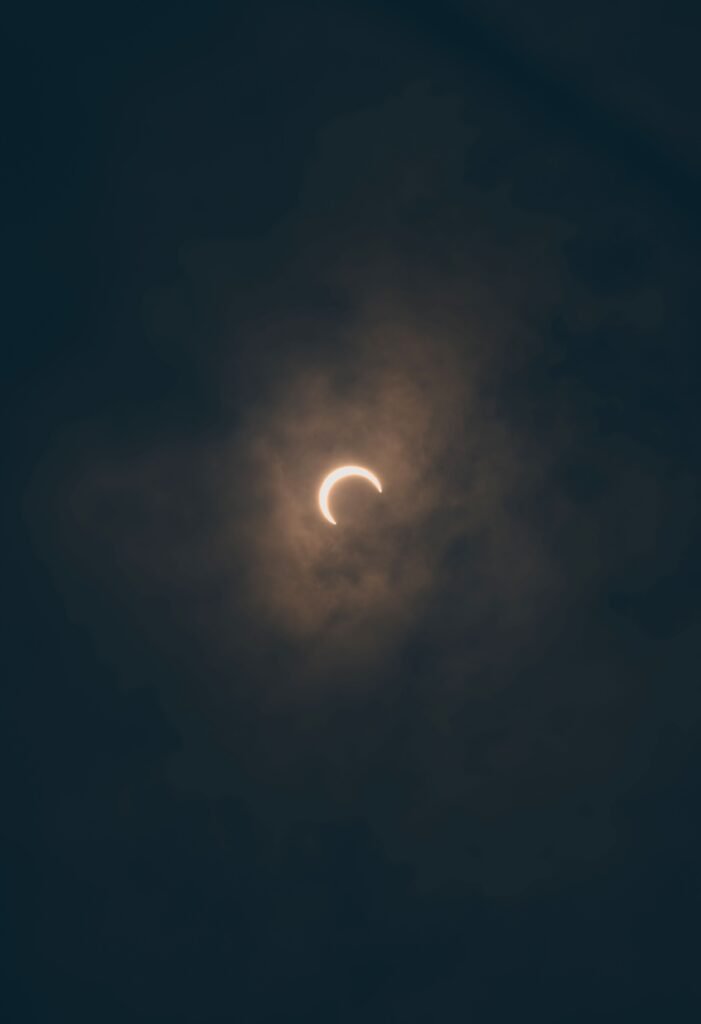
There are very few natural events that stop people in the middle of whatever they are doing, draw them outside, tilt their heads upward, and hold them in complete stillness. A solar eclipse is one of them. For a few minutes, the most ordinary thing in the sky, the sun that rises and sets every single day without asking for any attention, becomes the most extraordinary thing any of us has ever looked at.
But not all solar eclipses are the same experience. The four types, total, annular, partial, and hybrid, each produce a different visual phenomenon, occur under different geometrical conditions, and leave very different impressions on the people who witness them. A total solar eclipse and a partial solar eclipse are separated by far more than degrees. They are almost entirely different events.
Here is a clear explanation of all four types, what causes each one, what it looks and feels like to witness it, and what makes each type rare or relatively common.
First, the Basic Geometry That Makes Any Eclipse Possible
Before getting into the four types, here is the underlying mechanism that makes solar eclipses happen at all, because understanding it makes the differences between the types immediately logical rather than arbitrary.
A solar eclipse occurs when the Moon passes directly between the Earth and the Sun, casting a shadow on Earth’s surface. What makes this remarkable and what makes the different eclipse types possible is a coincidence of cosmic proportions: the Sun is approximately 400 times wider than the Moon but also approximately 400 times farther away from Earth. This means the two objects appear almost exactly the same size in Earth’s sky, which is why the Moon can sometimes cover the Sun almost perfectly and at other times fall just slightly short of full coverage.
The Moon’s orbit around Earth is not a perfect circle but an ellipse, meaning the Moon’s apparent size in our sky changes slightly as it moves closer to or farther from Earth. When the Moon is closer, it appears slightly larger and can cover the Sun completely. When it is farther away, it appears slightly smaller. This variation in apparent size, combined with the viewer’s position on Earth, is what produces the four distinct eclipse types.
1. Total Solar Eclipse: The Most Awe-Inspiring Event in Nature
A total solar eclipse occurs when the Moon is close enough to Earth in its orbit to appear at least as large as the Sun in the sky, and the alignment of the Sun, Moon, and Earth is precise enough that the Moon’s shadow falls directly on a specific region of Earth’s surface. Observers within that shadow, called the umbra, experience a total solar eclipse, watching the Moon’s disc cover the Sun completely.
What happens during totality is unlike anything else in ordinary human experience. The sky darkens to a deep twilight or near-night. Stars and planets become visible in the middle of the day. The temperature drops noticeably within minutes. Animals behave as though night has arrived suddenly. And the Sun’s corona, its outermost atmosphere, which is invisible under normal daylight, emerges as a shimmering, irregular halo of pale light surrounding the darkened Moon, a sight that is often described as one of the most beautiful things a human being can witness.
Totality itself lasts only a matter of minutes at any given location, sometimes as little as a few seconds at the edges of the path of totality. The path itself is a narrow band, typically around 100 to 160 kilometers wide, that sweeps across a portion of Earth’s surface as the Moon’s shadow travels. Observers outside this narrow path but still within a larger outer shadow zone, called the penumbra, see only a partial eclipse rather than totality.
Total solar eclipses occur somewhere on Earth roughly once every 18 months on average, but any given location on Earth’s surface experiences one only once every several hundred years on average, which is why people travel thousands of kilometers to stand in the path of totality for a few extraordinary minutes.
What it looks like: complete darkening of the sun, visible corona, stars appearing in daylight, and a sudden temperature drop.
2. Annular Solar Eclipse: The Ring of Fire
An annular solar eclipse occurs when the Moon is near the far end of its elliptical orbit and therefore appears slightly smaller in the sky than the Sun. When the alignment is otherwise the same as a total eclipse, the Moon’s disc covers the center of the Sun but leaves a visible ring of sunlight around its edges. This ring is what gives the annular eclipse its name, from the Latin word “annulus,” meaning “ring,” and what has earned it the popular nickname “the Ring of Fire.”
Visually, an annular eclipse is dramatic and striking but fundamentally different from a total eclipse in one critical way: at no point does the sky darken to twilight, stars become visible, or the corona emerge. Because the ring of sunlight remains visible throughout, the overall light level drops significantly but never reaches the near-darkness of totality. The ring itself, however, is a genuinely remarkable sight, a perfect circle of golden light with the black disc of the Moon suspended at its center.
Because the ring of exposed sunlight is intensely bright, observing an annular eclipse requires proper eclipse glasses or solar filters at all times, including during the maximum eclipse phase, unlike a total eclipse where it is safe to look directly at the corona during the brief moments of totality itself.
Annular eclipses occur slightly more frequently than total eclipses, since the Moon spends more of its orbit at distances that make it appear smaller than the Sun rather than larger.
What it looks like: A bright ring of sunlight surrounds the Moon’s dark disc, with no corona; the sky remains in bright or dim daylight throughout.
3. Partial Solar Eclipse: The Most Commonly Experienced Type
A partial solar eclipse occurs when the Sun, Moon, and Earth are not in perfect alignment, so the Moon covers only a portion of the Sun’s disc as seen from a given location on Earth. The Moon’s shadow passes across Earth in such a way that the observer is in the penumbra, the outer, partial shadow zone, rather than the umbra at the center of the shadow.
Partial eclipses are the most commonly experienced eclipse type because the penumbra covers a far larger area of Earth’s surface than the narrow path of totality or annularity. During a total or annular eclipse, millions of people across a wide region experience a partial eclipse of varying degrees while only a narrow strip of observers experiences totality or the ring of fire.
What a partial eclipse actually looks like depends heavily on how much of the Sun is covered. A deep partial eclipse where 80 to 90 percent of the Sun is obscured produces a noticeable darkening of daylight, a cooler feel to the air, and a distinctly eerie quality to outdoor light, since sunlight arrives from a crescent-shaped source rather than a full disc. A shallow partial eclipse of 10 to 20 percent coverage may be barely noticeable to the naked eye without a solar filter and can easily pass without a casual observer realizing it is happening.
Partial eclipses also occur as standalone events in polar regions where the Moon’s shadow never makes complete contact with Earth’s surface, producing a partial eclipse over a wide area without any accompanying total or annular phase anywhere on Earth.
What it looks like: A curved bite taken out of the Sun’s disc, ranging from barely noticeable to dramatic depending on coverage percentage. Always requires solar eclipse glasses for safe viewing.
4. Hybrid Solar Eclipse: The Rarest and Most Extraordinary Type
A hybrid solar eclipse, sometimes called an annular-total eclipse, is the rarest of the four types and perhaps the most geometrically fascinating. It occurs when the Moon is at a distance from Earth where its apparent size is right on the boundary between being able to cover the Sun completely and falling just short of full coverage.
Because Earth’s surface is curved, the distance between the Moon and different points on Earth’s surface varies slightly across the eclipse path. At the beginning and end of the eclipse track, where the Moon is slightly farther from the curved surface of Earth, it appears just too small to cover the Sun completely, and those observers see an annular eclipse with a ring of sunlight. Toward the middle of the eclipse track, where Earth’s curved surface brings those observers fractionally closer to the Moon, the Moon appears just large enough to cover the Sun entirely, and those observers see a total eclipse with full darkening and a visible corona.
The result is a single eclipse event that transitions from annular to total and back to annular along its path across Earth’s surface, with different observers in different sections of the path experiencing fundamentally different eclipse types from the same event. Hybrid eclipses account for only about 5 percent of all solar eclipses, making them the rarest type by a significant margin.
What it looks like: Depends entirely on where the observer stands within the eclipse path. Annular ring effect at the path edges, full totality with corona and darkened sky at the central portion of the track.
A Quick Comparison at a Glance Frequently Asked Questions
Q1: Which type of solar eclipse is the rarest?
Hybrid solar eclipses are the rarest, accounting for roughly 5 percent of all solar eclipses. They occur when the Moon is at precisely the orbital distance where it is right on the boundary between producing a total and an annular eclipse, causing different parts of the eclipse path to experience different eclipse types.
Q2: Is it ever safe to look directly at a solar eclipse without glasses?
Only during the brief totality phase of a total solar eclipse, when the Sun’s disc is completely covered and only the corona is visible. At all other times, including during partial, annular, and hybrid eclipses and during every phase of a total eclipse outside totality itself, looking directly at the Sun without certified solar eclipse glasses causes permanent eye damage.
Q3: Why does the sky go dark during a total eclipse but not during an annular one?
During a total eclipse, the Moon completely blocks the Sun’s photosphere, the bright disc that produces virtually all of the Sun’s visible light. During an annular eclipse, the ring of exposed photosphere around the Moon’s edge continues to produce intense light, keeping the sky in daylight conditions throughout the event.
Q4: Can the same eclipse be total for some observers and annular for others?
Yes, but only in a hybrid eclipse. Because Earth’s surface curves, the distance between the Moon and different points on the eclipse path varies slightly, causing the Moon to appear fractionally larger or smaller depending on where the observer stands. This allows a single eclipse to produce totality along the central section of its path and an annular ring at the path’s beginning and end.
Q5: How often does a total solar eclipse occur at any given location?
A total solar eclipse passes over any specific location on Earth’s surface on average once every 375 years, though the actual distribution is uneven and some locations may wait much longer between events. This rarity is why dedicated eclipse chasers travel globally to position themselves in the narrow path of totality whenever one occurs.
Four types, four different relationships between three celestial objects measured in distances of millions of kilometers, and yet the differences between them come down to a matter of kilometers on Earth’s surface and arc seconds in apparent angular size. That the Moon and Sun appear almost exactly the same size from Earth, despite being nothing alike in scale, is the coincidence that makes all four types of solar eclipse possible and the one that makes totality, when it happens, feel less like an astronomical event and more like something the universe arranged specifically to be witnessed.

My work focuses on finding the human stories behind the headlines, from documenting unique cultural traditions to covering stories from communities across Bengal. Previously, I worked as an SEO Content Writer with Penning Down and Collegedunia, combining digital content expertise with newsroom journalism.
I believe impactful journalism is built on accuracy, empathy, and stories that stay with readers.
- Cocoa Butter Formula, Body Massage Lotion for Stretch Marks - April 9, 2016
- Ultra-calming makeup removing wipes - April 9, 2016
- Eczema therapy hand cream - April 9, 2016
Blog Insights
View All CouponTalk Blogs
12 Best LED Lighting Brands In India

10 Best Water Pump Brands In India

10 Best RO Membrane Brands In India

10 Best Electric Wire Brands In India

10 Best Electric Pressure Cooker Brands In India

10 Best Air Fryer Brands In India






15 Different Types of Handbags for Ladies



10 Best Air Cooler Brands In India


