8 Planets in Our Solar System: Order, Size & Facts

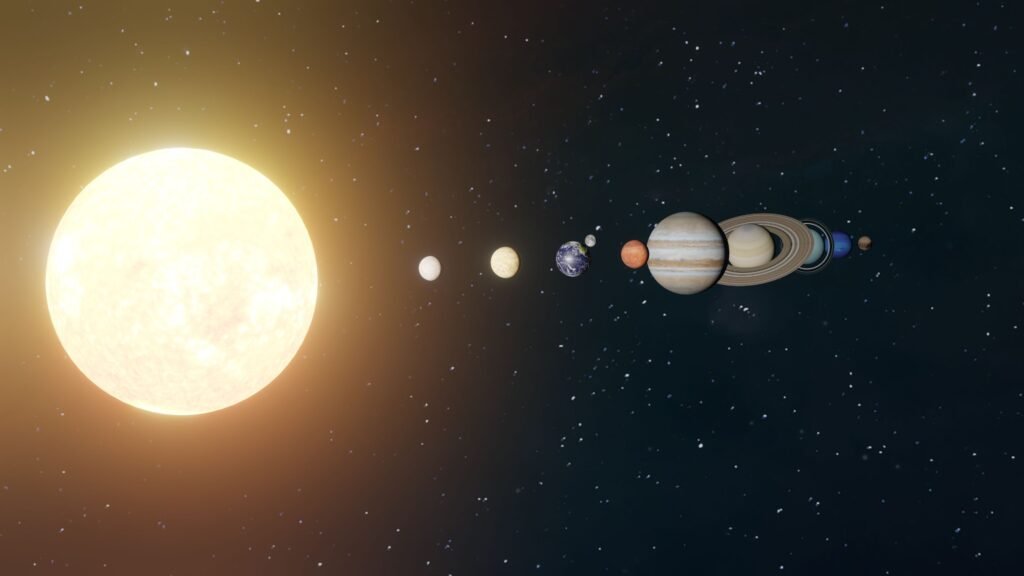
Picture this. It is a clear night. You step outside, look up, and somewhere in that vast, ink-dark sky, eight worlds are silently going about their business, spinning, orbiting, raging with storms, wrapped in rings, or sitting quietly in the cold. All of them are bound to the same star. All of them are part of the same family.
That family is our solar system, and the eight planets in it each have a story worth knowing.
Whether you are a curious student, a parent answering a child’s bedtime question, or simply someone who once looked up and wondered, this guide walks you through all eight planets, in order, with their sizes and the most fascinating facts each one carries.
First, a Quick Map of How It All Lines Up
Before diving into each world, here is the essential framework. When people ask how many planets are in our solar system, the answer has been eight since 2006, when the International Astronomical Union formally defined what counts as a planet, and Pluto, much to many people’s disappointment, did not make the cut.
The eight planets, in order of their distance from the Sun, are: Mercury, Venus, Earth, Mars, Jupiter, Saturn, Uranus, and Neptune. A helpful way to remember them: My Very Educated Mother Just Served Us Nachos.
The first four Mercury through Mars are rocky, relatively small, and sit in the inner solar system. The final four, Jupiter through Neptune, are giants made mostly of gas or ice, orbiting far from the Sun in the cold outer reaches of our neighborhood.
1. Mercury The Swift and the Scorched
Mercury is the smallest planet in our solar system and the closest to the Sun, yet it is not the hottest. That title belongs to Venus. Mercury lacks an atmosphere thick enough to trap heat, so temperatures swing wildly from 430°C during the day to -180°C at night.
Size: About 4,879 km in diameter, roughly 38% the size of Earth.
Distance from Sun: 57.9 million km
One year: Just 88 Earth days
Fascinating fact: A day on Mercury (one full rotation) actually lasts longer than a year on Mercury. It rotates so slowly that the Sun rises, sets, and rises again before Mercury even completes one full orbit.
Among the many planets in our solar system, Mercury is the one that most dramatically shows the difference between being close to the Sun and being hot, an important reminder that atmosphere, not proximity alone, determines temperature.
2. Venus Beautiful, Bright, and Brutal
Venus is the brightest object in the night sky after the Moon, and from a distance, it looks serene and inviting. Get closer, and the picture changes completely. Venus has an atmosphere so thick with carbon dioxide and sulphuric acid clouds that the greenhouse effect has turned it into the hottest planet in our solar system, with surface temperatures averaging around 465°C.
Size: 12,104 km in diameter, almost a twin of Earth in size.
Distance from Sun: 108.2 million km
One year: 225 Earth days
Fascinating fact: Venus rotates backwards compared to most planets, and does so incredibly slowly. A single Venusian day is longer than a Venusian year. If you stood on Venus (which no human could survive), the Sun would rise in the west and set in the east.
3. Earth The One We Call Home
In any honest list of how many planets are in our solar system, Earth deserves a moment of quiet appreciation. It is the only known world with liquid water on its surface, a breathable atmosphere, and life in staggering abundance from deep ocean trenches to mountain peaks.
Size: 12,742 km in diameter
Distance from Sun: 149.6 million km
One year: 365.25 days
Fascinating fact: Earth is not perfectly round. It bulges slightly at the equator due to its rotation, making the equatorial diameter about 43 km larger than the polar diameter. The mountain with its peak farthest from Earth’s core is not Everest; it is Mount Chimborazo in Ecuador, due to this equatorial bulge.
4. Mars, the Red Planet with Big Dreams
Mars has captured human imagination for centuries, and in our own time, it has become the destination humanity is actively preparing to visit. Its reddish surface comes from iron oxide, essentially rust, covering much of its terrain.
Size: 6,779 km in diameter, about half the size of Earth.
Distance from Sun: 227.9 million km
One year: 687 Earth days
Fascinating fact: Mars is home to Olympus Mons, the largest volcano in our solar system. It stands nearly three times the height of Mount Everest and is so wide that if you stood at its base, the edges would be beyond the horizon. Mars also has the deepest canyon system, Valles Marineris, stretching over 4,000 km long and 7 km deep.
Among all the planets in our solar system, Mars is the one most seriously discussed as a future human habitat, largely because its day is remarkably similar to Earth’s, just 24 hours and 37 minutes long.
5. Jupiter King of the Planets
Cross the asteroid belt, and you enter the territory of giants. Jupiter is not just the largest planet in our solar system; it is larger than all other planets combined. Its mass is so great that some astronomers describe it as almost a failed star.
Size: 139,820 km in diameter, about 11 times wider than Earth.
Distance from Sun: 778.5 million km
One year: About 12 Earth years
Fascinating fact: The Great Red Spot on Jupiter is a storm that has been raging continuously for at least 350 years, possibly much longer. This storm alone is wider than the entire Earth. Jupiter also has at least 95 known moons, including Europa, a world with a subsurface ocean that scientists consider one of the most promising places to search for extraterrestrial life.
6. Saturn The One with the Rings
If you showed a child a picture of Saturn and asked which planet it was, most would answer correctly without hesitation. Saturn’s rings are its signature, a stunning system of ice and rock particles stretching hundreds of thousands of kilometres from the planet, yet only about 10 to 100 metres thick in most places.
Size: 116,460 km in diameter, about 9.5 times wider than Earth.
Distance from Sun: 1.43 billion km
One year: About 29.5 Earth years
Fascinating fact: Saturn is the least dense planet in our solar system. It is so light relative to its size that it would float on water if there were an ocean large enough to hold it. Among the planets in our solar system, Saturn has the most visually dramatic presence, and its moon Titan, with a thick atmosphere and lakes of liquid methane, is one of the most Earth-like worlds we know of, despite being nothing like Earth at all.
7. Uranus: The Planet That Rolls
Uranus is the first planet too faint to see reliably with the naked eye, and in many ways, it is the most unusual of all eight planets in our solar system. It rotates on its side, tilted at roughly 98 degrees, meaning it essentially rolls around the Sun like a bowling ball rather than spinning upright like a top.
Size: 50,724 km in diameter, about four times wider than Earth.
Distance from Sun: 2.87 billion km
One year: About 84 Earth years
Fascinating fact: Because of its extreme tilt, Uranus has the most dramatic seasons of any planet. Each pole experiences about 42 years of continuous sunlight followed by 42 years of continuous darkness. Despite being farther from the Sun, Uranus is not the coldest planet; Neptune is, but only barely. Uranus holds the record for the coldest temperature ever recorded in our solar system: -224°C.
8. Neptune The Windy Frontier
Neptune is the eighth and final planet in our solar system, the farthest from the Sun, the windiest, and in many ways the most remote and mysterious. It was not discovered by observation alone; its existence was predicted mathematically before anyone looked for it, based on disturbances in Uranus’s orbit.
Size: 49,244 km in diameter, slightly smaller than Uranus but significantly more massive.
Distance from Sun: 4.5 billion km
One year: About 165 Earth years
Fascinating fact: Neptune has the fastest winds of any planet in our solar system, with gusts reaching up to 2,100 km/h, faster than the speed of sound on Earth. Its largest moon, Triton, orbits backwards relative to Neptune’s rotation, suggesting it was captured from elsewhere in the solar system rather than forming alongside it.
When thinking about how many planets are in our solar system, Neptune is a reminder that the boundary of our planetary family is not an edge, but a threshold beyond which lies the Kuiper Belt, and then the vast interstellar space that separates us from the next star.
Frequently Asked Questions
Q1: How many planets are in our solar system right now?
Eight. Mercury, Venus, Earth, Mars, Jupiter, Saturn, Uranus, and Neptune. Pluto was reclassified as a dwarf planet in 2006 by the International Astronomical Union, reducing the count from nine to eight.
Q2: Which is the hottest planet in our solar system?
Venus, not Mercury. Although Mercury is closer to the Sun, Venus has a thick atmosphere that traps heat through the greenhouse effect, keeping its surface temperature around 465°C at all times.
Q3: What is the biggest planet in our solar system?
Jupiter, by a very large margin. It is more than twice as massive as all the other planets in our solar system combined.
Q4: Which planet has the most moons?
As of 2026, Saturn holds the record with over 140 confirmed moons, narrowly ahead of Jupiter’s 95+ moons. Both counts continue to grow as better telescopes reveal smaller, previously undetected satellites.
Q5: Could there be a ninth planet in our solar system?
Possibly. Some astronomers have proposed a theoretical “Planet Nine” based on unusual gravitational patterns observed in the outer solar system. As of now, it has not been directly observed, but the search continues.
Eight worlds. One star. Billions of years of quiet motion through space. The next time you look up at a clear night sky, that sense of wonder you feel is not small at all, it is exactly the right size.

My work focuses on finding the human stories behind the headlines, from documenting unique cultural traditions to covering stories from communities across Bengal. Previously, I worked as an SEO Content Writer with Penning Down and Collegedunia, combining digital content expertise with newsroom journalism.
I believe impactful journalism is built on accuracy, empathy, and stories that stay with readers.
- Amazon Coupon Code: Up to 70% Off Your Order - October 10, 2024
- Amazon Brand – Solimo 1000ml Stainless Steel Insulated (Thermosteel) Water Bottle | 24 Hours Hot and Cold | Leakproof, Rust and Corrosion Resistant| For Travel, Office, Trekking, Home (Silver) - October 9, 2024
- Panasonic Portable Oral Irrigator/Dental Water Flosser - April 10, 2016
Blog Insights
View All CouponTalk Blogs
12 Best LED Lighting Brands In India

10 Best Water Pump Brands In India

10 Best RO Membrane Brands In India

10 Best Electric Wire Brands In India

10 Best Electric Pressure Cooker Brands In India

Types of Gearbox

5 Best Camera Brands In India

11 Different Types of Embroidery With Name

10 Different Types of Heels Sandals For Ladies