Best Digital Bike Speedometer in India Under ₹500

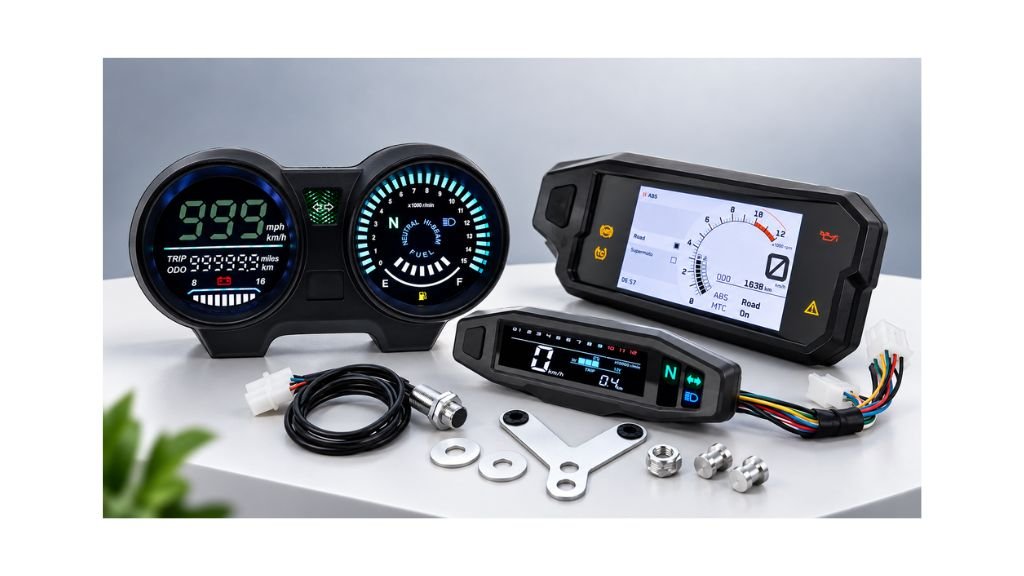
The original speedometer on a Splendor has been reading about 10 kmph optimistically since the day it left the showroom. Most riders know this, compensate for it automatically, and do not think too much about it. Then the cable snaps, or the needle starts sticking, or the dial cracks after a fall, and suddenly there is a decision to make. Replace the original with an identical cable-driven unit, or swap in one of the digital speedometers that have been flooding the market at prices that start below ₹400.
A lot of riders choose the digital option. The display is easier to read at a glance. Many units show odometer, trip meter, time, and voltage on the same screen. They look noticeably more modern on a bike that might otherwise be ten years old. And at this price range, the cost of trying one is low enough that even if it disappoints, the experiment did not hurt much.
But the market under ₹500 for digital speedometers in India is about as inconsistent as any product category gets. Some units hold their calibration for years. Others drift by 15 to 20 percent within a few months. Some have displays that wash out completely in direct afternoon sun. Some require a wheel sensor that needs careful mounting to work reliably, and a sensor mounted at the wrong gap from the magnet reads incorrectly from day one.
The difference between a unit that earns its place on the handlebar and one that ends up in a drawer comes down to a few specific things. Here is what those things are, and which products at this price actually deliver on them.
First, a Word About How Budget Digital Speedometers Work
Most digital speedometers in this price range use a magnetic sensor mounted near the wheel and a small magnet fixed to a spoke. Every time the magnet passes the sensor, the unit counts one wheel rotation. By measuring how much time passes between rotations and multiplying by the wheel circumference you enter during setup, it calculates speed.
That working principle has two practical consequences worth knowing before buying anything.
The first is that accuracy depends on how correctly you enter the wheel circumference during setup. A wrong number gives a wrong speed, consistently and permanently, until you correct it. Every unit on this list requires this setup step. Most product listings do not mention it clearly. If you have never done it before, it takes five minutes, and the correct circumference figure for your tyre size is available on any tyre sidewall or in a quick search.
The second consequence is that the sensor gap matters. The sensor needs to be close enough to the magnet to register each pass without touching it. Most manufacturers specify a gap of 3 to 5 mm. A gap that is too wide produces missed pulses, which read as a speed lower than the actual. A gap that slowly widens as the spoke flexes produces a speed reading that gradually drops over weeks and makes the unit look like it is drifting when the real issue is physical mounting.
Understanding these two things solves most of the complaints people have about budget digital speedometers before they even start shopping.
1. Nippon Digital Speedometer With LED Display: The Most Widely Used Budget Pick
Nippon sells motorcycle electrical accessories through a wide distributor network across India, and the Nippon digital speedometer is probably the most commonly fitted aftermarket digital unit on Indian commuters right now, largely because it is available at almost every spare parts shop in the country rather than only online.
The display is a blue backlit LCD that reads clearly in most lighting conditions, though in direct, harsh sunlight in the early afternoon, it requires a deliberate glance rather than a casual one. It shows speed, odometer, two trip meters, time, and a low-voltage warning. Installation uses the magnetic sensor and spoke magnet system described above, and the wiring runs to the bike’s battery with a fused lead included in the box.
It holds calibration well once set up correctly. The unit does not drift significantly over time, which is the complaint that kills most competing products at this price. The plastic casing is basic but adequate for normal weather, and the connector plugs are waterproofed with rubber sleeves rather than left open.
Pricing typically falls between ₹280 and ₹420 at local shops, slightly higher online with shipping.
Best for: Riders replacing a broken factory speedometer on a commuter like a Splendor, Passion, or HF Deluxe who want a unit that can be sourced locally and serviced or replaced without ordering online.
2. Baaqii Digital Speedometer With Odometer: The Online Bestseller
Baaqii is an Indian brand that has built a strong presence specifically through e-commerce, and the digital speedometer it sells is consistently one of the highest-reviewed units in this category on Amazon India and Flipkart. The reason it shows up well in reviews is partly that the display is brighter than most competing units and partly that the product listing includes better setup instructions than almost anything else at this price.
The unit shows speed, total odometer, two trip meters, time, and a battery voltage reading. The display uses a larger digit size than the Nippon unit, which makes it easier to read while moving rather than only when stopped. The casing has a slightly more finished look than the bare Nippon housing, with a dark surround that blends reasonably well on most handlebars.
The sensor and magnet system work on the same principle as every other unit in this category. Still, the included sensor cable is longer than average at around 1.5 metres, which makes routing the cable neatly on larger bikes considerably easier than on units that ship with barely enough length to reach from the front wheel to the handlebars.
Pricing typically falls between ₹320 and ₹480 online.
Best for: Riders who buy online and want a unit with a brighter display and clearer setup instructions, particularly on bikes where the cable run from the front wheel to the handlebar is longer than average.
3. Speedwav Digital Speedometer: The Best Sunlight Readability Pick
Speedwav sells a range of motorcycle accessories across Indian e-commerce platforms, and their digital speedometer is notable for one specific reason that matters considerably on a daily commuter in India: the display is a negative LCD type, which means light digits on a dark background rather than dark digits on a light background.
Negative LCDs read better in direct sunlight than standard positive LCDs because the contrast relationship works in the display’s favour when ambient light is bright rather than against it. Riders who do most of their commuting between 11 am and 3 pm, when sun angles make standard displays wash out, consistently report the Speedwav unit as the most readable option they have tried at this price point.
It shows the same core functions as the other units on this list. Speed, odometer, trip meters, time, and voltage. The casing is average in quality but functional, and the included instructions are basic enough that first-time installers will benefit from watching a YouTube installation guide alongside rather than relying on the paper insert alone.
Pricing typically falls between ₹350 and ₹490.
Best for: Riders who commute in full sunlight on exposed roads and have found standard LCDs difficult to read on their existing instruments. Also a good pick for bikes parked facing east, where the morning ride happens directly into the sun.
4. Motofit Universal Digital Speedometer With RPM: The Feature-Heavy Surprise
Most digital speedometers under ₹500 show speed and basic trip data. The Motofit unit adds an RPM reading by tapping into the ignition coil signal, which gives it a functionality step above everything else in this price range. For riders on bikes whose original tachometer has failed, or bikes that never came with a tachometer at all, getting an RPM reading alongside speed on a single unit is a meaningful upgrade.
The installation is more involved than a pure speed-only unit because the RPM pickup wire needs to connect to the coil rather than only routing a sensor to the front wheel. This is straightforward for anyone who has done basic wiring on a bike, and most local mechanics can do it during a normal service visit. For someone with no experience touching bike wiring, it adds a step.
The display is bright enough for most conditions, and the housing is slightly larger than the compact units on this list, which accommodates the additional information shown without cramping the digits to the point of unreadability.
Pricing typically falls between ₹420 and ₹500, right at the top of this list’s budget.
Best for: Riders who want a tachometer alongside a speedometer and whose bikes either lack a factory tacho or have a failed one. Also worth considering for riders learning to read engine revs to improve gear shifting habits on a commuter.
5. Generic Universal Digital Speedometer (Unbranded): The Try-Before-You-Invest Option
Across Amazon India, Flipkart, and local spare parts shops, a category of fully generic, unbranded digital speedometers exists at the ₹180 to ₹320 price range that is worth addressing directly rather than pretending it does not exist.
These units share a near-identical housing design and circuit board across dozens of listings, varying only in the sticker on the packaging and the wire colours used. Build quality is inconsistent from batch to batch. Some riders get a unit that works well for two years. Others get one that reads incorrectly from setup day, or whose display connector loosens after the first monsoon and produces a flickering reading.
The honest case for buying one is that at ₹200 or ₹250, finding out whether you like riding with a digital speedometer before spending ₹400 on a branded unit is a legitimate use of the category. The honest case against is that the failure rate is high enough that many buyers end up buying twice, and two generic units cost more than one Nippon or Baaqii.
Pricing is between ₹180 and ₹320.
Best for: Riders who want to test the format at minimum cost before deciding whether to invest in a better unit. Not recommended as a permanent replacement if the bike is ridden daily.
How to Actually Choose Between These
If you want to buy from a local shop and have it fitted the same day, the Nippon unit is the most widely stocked option across spare parts markets in most Indian cities and towns.
If you are ordering online and want the best display readability for the money, the Baaqii unit’s brighter display and better-documented setup make it an easier installation experience.
If direct sunlight readability is the specific problem you are trying to solve, the Speedwav negative LCD addresses it in a way the other units in this category do not.
If you want a tachometer alongside a speedometer and your bike does not have one, the Motofit unit is the only option on this list that provides it within the budget.
If you are not sure whether you want a digital speedometer at all, an unbranded unit at ₹200 to ₹250 is a low-cost way to find out.
What a Budget Digital Speedometer Cannot Fix
The accuracy of any unit in this category is directly tied to the care taken during initial setup and sensor mounting. A unit installed in ten minutes without reading the setup instructions will not read correctly. That is not a product failure. It is a setup failure, and it is one of the main reasons digital speedometers at this price get poor reviews that have nothing to do with the unit’s actual capability.
None of these units is waterproof in the sense that a fully submerged or pressure-washed unit will survive intact. They are water-resistant under normal riding conditions, including rain. Parking the bike uncovered in heavy rain for extended periods is not what the housings are rated for, and the display connector area is the most vulnerable point on every unit here.
None of these speedometers logs trip data between power cycles without a battery backup capacitor, and at this price range, none of them have one. Trip meter data resets when the ignition is cut, and the unit loses power, which is a known limitation of the category rather than a defect in any specific product.
Speed readings on all sensor-based units have a slight lag of around one to two seconds behind actual speed changes. This is inherent to the pulse-counting measurement method and is normal. It means the displayed speed during hard acceleration or braking is always slightly behind reality, which is worth knowing rather than treating as a malfunction.
Frequently Asked Questions
Q1: How do I set the correct wheel circumference on a digital speedometer?
Look at your tyre sidewall for the tyre size code. A tyre marked 2.75-18 on most 100cc commuters has a circumference of approximately 1570 mm. A 90/90-17 tyre used on many 125cc bikes has a circumference of approximately 1680 mm. Most units accept this value in millimetres during the initial setup sequence described in the instruction sheet. Entering the correct value is the single most important step for accurate readings.
Q2: Can I install a digital speedometer myself, or do I need a mechanic?
Most riders with basic familiarity with their bike’s wiring can install these themselves in 30 to 45 minutes. The connections involved are the battery positive and negative for power, and the sensor wire to the front wheel. A mechanic at a local shop can also do it during a standard service visit for a small labour charge, usually between ₹100 and ₹200.
Q3: Will a digital speedometer work on any bike?
Yes, the sensor and magnet system is universal and works on any bike with wire spokes or alloy wheels, where the magnet can be attached to the wheel and the sensor mounted on the fork leg. The only fitment requirement is that the sensor cable is long enough to reach from the front wheel to the handlebar mount.
Q4: Why is my digital speedometer reading lower than my actual speed?
The most common cause is a sensor gap that is too wide, causing the unit to miss some magnet passes. Check that the sensor is within 3 to 5 mm of the magnet at the closest point of its rotation. The second most common cause is an incorrect wheel circumference value entered during setup. Check and correct both before assuming the unit is faulty.
Q5: Do these units show fuel level?
No unit in this price range includes a fuel level display because fuel level sensing requires a connection to the fuel tank sender unit, which varies by bike model and cannot be standardised for a universal aftermarket product. The fuel level display is found on model-specific digital clusters priced significantly higher than the units on this list.
Final Thoughts
That broken cable on the Splendor at the start of this piece is waiting for a decision. An identical replacement cable and dial assembly costs between ₹200 and ₹350 and puts things back exactly as they were, optimistic reading and all. A digital unit from this list costs between ₹280 and ₹500, takes an afternoon to fit, and gives a more accurate reading alongside a handful of functions the original analogue dial never had.
Neither answer is wrong. One preserves what was there. The other replaces it with something that does more. Set the wheel circumference correctly, mount the sensor at the right gap, and the digital unit earns its place on the handlebar the first time you glance down and actually trust what it says.

My work focuses on finding the human stories behind the headlines, from documenting unique cultural traditions to covering stories from communities across Bengal. Previously, I worked as an SEO Content Writer with Penning Down and Collegedunia, combining digital content expertise with newsroom journalism.
I believe impactful journalism is built on accuracy, empathy, and stories that stay with readers.
- Cocoa Butter Formula, Body Massage Lotion for Stretch Marks - April 9, 2016
- Ultra-calming makeup removing wipes - April 9, 2016
- Eczema therapy hand cream - April 9, 2016
Blog Insights
View All CouponTalk Blogs
12 Best LED Lighting Brands In India

10 Best Water Pump Brands In India
10 Best RO Membrane Brands In India
10 Best Electric Wire Brands In India

10 Best Electric Pressure Cooker Brands In India

10 Best Air Fryer Brands In India




Types of Watches In India

10 Best Tyre Brands In India
10 Best Ro Booster Pump Brands In India

10 Best Flood Light Brands In India