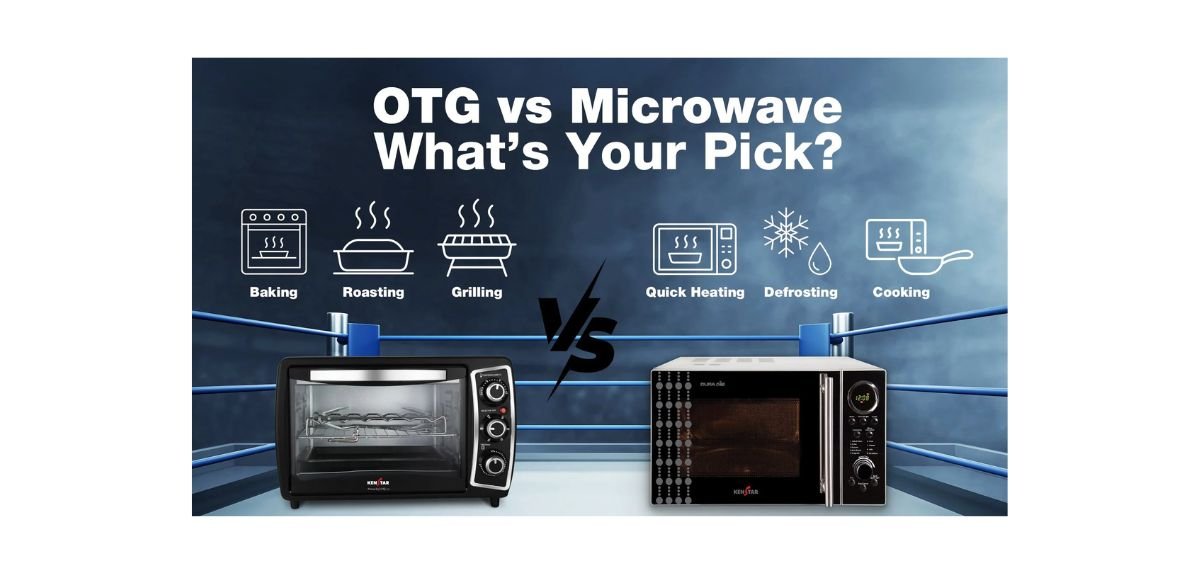
You want to bake a soft, golden nankhatai for Diwali. Or maybe a chocolate birthday cake from scratch. Or crispy paneer tikka for a Sunday party. The question everyone asks before buying their first kitchen appliance is simple: OTG or microwave?
Both heat food. Both sit on your kitchen counter. But they work in completely different ways. And for baking, one of them is clearly the better option.
This guide gives you a straight answer, backed by what each appliance actually does, what it costs in India, and which one makes sense for your kitchen and cooking habits.
OTG vs Microwave Oven
What Is an OTG Oven?
OTG stands for Oven, Toaster, and Griller. It is a compact electric oven that uses metal heating coils at the top and bottom of the cooking chamber. When you switch it on, those coils heat up and radiate dry heat directly onto your food.
Think of it as a smaller, more affordable version of the big oven you see in bakeries. The heat comes from both sides, which gives your baked goods an even rise and a golden-brown crust on top and bottom.
How it works: The top coil heats food from above (for grilling and browning). Bottom coil bakes from below. Both coils together give you even baking. Convection OTGs also have a fan that circulates the hot air for uniform results.
OTG Sizes and Prices in India
- 9L to 15L: Rs. 2,500 to Rs. 4,000. Good for singles or couples. Fits 1 tray of cookies.
- 19L to 25L: Rs. 4,000 to Rs. 7,500. Best for small families. Fits a 1 kg cake tin.
- 35L to 45L: Rs. 7,000 to Rs. 13,000. Good for medium to large families. Multiple trays, whole chicken, large pizzas.
- 60L: Rs. 12,000 to Rs. 18,000. For heavy baking, home bakers who sell, or large joint families.
What an OTG Does Well
- Baking cakes, cookies, bread, nankhatai, muffins, brownies
- Grilling paneer tikka, chicken, fish, and vegetables
- Toasting bread, buns, sandwiches
- Making pizza with a crispy base
- Roasting whole chicken, potatoes, and vegetables
- Tandoori-style cooking with skewers and a grill rack
What an OTG Cannot Do
- Defrost frozen food (no microwave function)
- Heat leftover dal or sabzi quickly (takes 10 to 15 min vs 2 min in microwave)
- Cook rice, pasta, or steamed dishes
What Is a Microwave Oven? (3 Types Explained)
Most people think “microwave” is one product. It is actually three different things. Buying the wrong type is a common and expensive mistake.
Type 1: Solo Microwave
Uses electromagnetic waves to heat the water molecules inside your food. It cooks fast and from the inside out. A solo microwave is great for reheating dal, defrosting chicken, heating milk, or cooking Maggi. But it cannot brown or crisp food. You cannot bake a proper cake in it.
Price range: Rs. 4,000 to Rs. 8,000. Sizes: 17L to 25L.
Type 2: Grill Microwave
A solo microwave with an added heating coil on top. This gives you some browning and crisping, which the solo type cannot do. You can grill sandwiches, toast bread, or lightly crisp chicken. However, it still cannot bake a proper cake with even rise and a brown crust on all sides.
Price range: Rs. 6,000 to Rs. 12,000. Sizes: 20L to 28L.
Type 3: Convection Microwave
This is the one that can actually bake. It combines microwave technology with a convection heating element and fan. You can bake cookies, small cakes, and muffins in it. However, it still does not match an OTG for baking quality. The results are decent but not as crispy or evenly browned.
The convection microwave also preheats faster than an OTG (5 to 8 minutes vs 15 to 20 minutes). This makes it convenient for occasional bakers who also need to reheat and defrost daily.
Price range: Rs. 10,000 to Rs. 30,000. Sizes: 20L to 35L.
Important: If someone tells you “a microwave can bake,” they usually mean a convection microwave. A solo or grill microwave cannot bake cakes or cookies properly.
OTG vs Microwave: Full Comparison Table
| Factor | OTG | Microwave (Solo) | Convection Microwave |
| Best For | Baking, grilling, and toasting | Reheating, defrosting | Baking + reheating + defrosting |
| Baking Quality | Excellent (crispy, golden crust) | Poor (no browning) | Good (not as crisp as OTG) |
| Preheat Time | 15 to 20 minutes | None (instant) | 5 to 8 minutes |
| Cooking Speed | Slower (30 to 45 min for cake) | Very fast (5 to 10 min) | Medium (faster than OTG) |
| Capacity | 9L to 60L | 15L to 40L | 20L to 35L |
| Price Range | Rs. 3,000 to Rs. 15,000 | Rs. 4,000 to Rs. 12,000 | Rs. 10,000 to Rs. 30,000 |
| Power Use | 800W to 2,500W (longer time) | 700W to 1,200W (shorter time) | 900W to 1,500W |
| Reheating | Yes, but slow and drying | Excellent, fast, and moist | Excellent |
| Defrosting | No | Yes | Yes |
| Indian Baking | Nankhatai, cakes, pizza, bread | Quick mug cakes only | Decent for small bakes |
| Tandoori Grilling | Excellent (dry heat, charred texture) | Limited (grill models only) | Good (with grill mode) |
| Ease of Use | Knob-based, simple | Digital, one-touch presets | Digital, more complex |
| Cleaning | Racks and trays need scrubbing | Wipe the interior after each use | Wipe the interior after each use |
| Size / Countertop | Larger footprint | Compact | Compact |
Baking Performance: Why OTG Wins for Indian Home Bakers
This is the most important section if baking is your priority.
How OTG Baking Works
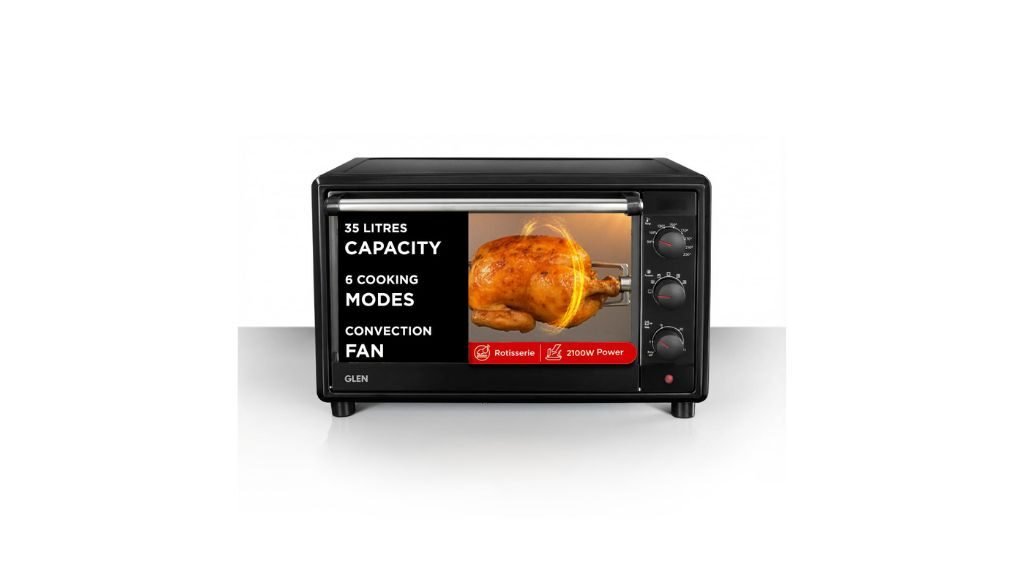
The heating coils in an OTG radiate dry heat directly onto your food from above and below. This creates the same conditions as a traditional clay or tandoor oven. Your cake gets heat from the bottom (so it rises evenly) and from the top (so it browns properly).
A 1 kg chocolate cake takes about 35 to 45 minutes in an OTG at 180 degrees Celsius. When you take it out, the top is golden brown, the sides have cleanly pulled away from the tin, and the crumb inside is soft and even. That is what good baking looks like.
How Convection Microwave Baking Works
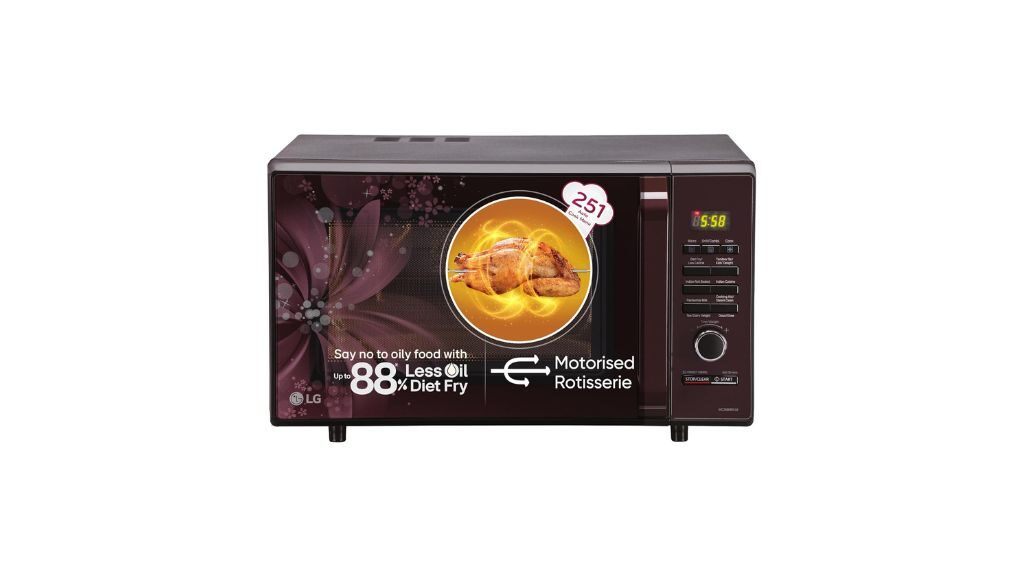
A convection microwave circulates hot air around the food using a fan. The heat is more uniform than a solo microwave but lacks the focused intensity of OTG coils. The crust tends to be softer. Browning on the bottom is weaker. For a small mug cake or a batch of soft cookies, the results are acceptable. For a layered birthday cake or a crispy pizza base, the OTG gives better results.
The practical difference: an OTG-baked nankhatai has a light, sandy, slightly crispy bottom and a golden top. The same nankhatai in a convection microwave is softer and less golden. Both are edible. Only one looks and tastes like it came from a proper bakery.
Suggested Read: 9 Best Microwave Oven Brands In India
Indian Festive Baking and OTGs
If you bake for festivals and occasions, the OTG is your appliance. These tasks are hard or impossible in a convection microwave:
- Nankhatai (traditional Indian shortbread) needs dry, even heat for the right sandy crumble
- Cake rusk (for chai time) needs low-temperature drying over 30 to 40 minutes
- A whole chicken roast for a dinner party needs even radiant heat from all sides
- Diwali cookie batches of 20 to 30 pieces at once need a 35L or larger OTG
- Homemade pizza needs a bottom heat intense enough to crisp the base
The Preheat Time Tradeoff
An OTG needs 15 to 20 minutes to preheat. A convection microwave needs 5 to 8 minutes. If you bake twice a week, the extra 10 to 15 minutes per session adds up to about 17 hours of extra waiting over a year. That is the real cost of the OTG’s slower preheat. It is worth it if you care about results. It is annoying if you just want a quick bake without planning ahead.
OTG vs Microwave for Indian Cooking: Real Use Cases
For Daily Indian Cooking
Microwave wins here without question. Reheating yesterday’s dal takes 2 minutes in a microwave. It takes 12 to 15 minutes in an OTG and dries out the dal. Defrosting frozen matar or chicken in the morning before cooking takes 5 minutes in a microwave. An OTG cannot defrost.
If your kitchen routine is rice, dal, sabzi, roti, and occasional reheating, a microwave is the practical choice for daily use.
For Grilling and Tandoori Dishes
OTG is better for tandoori-style cooking. The dry, radiant heat from the grill coil gives chicken, paneer, and fish a charred exterior and a smoky texture that is hard to replicate in a microwave. OTGs with a rotisserie skewer function let you cook whole tandoori chicken at home. Some 35L and 45L OTGs also have a motorised rotisserie for even rotation.
A grill microwave can do basic grilling (chicken pieces, paneer tikka), but the texture is softer and less charred. Good enough for a quick weeknight meal, not ideal for a dinner party centerpiece.
For Baked Indian Snacks
Baked samosas, bread rolls, veg puffs, and baked mathri are increasingly popular in Indian home kitchens as healthier alternatives to deep-frying. An OTG handles all of these with ease and gives them a genuinely crispy exterior. A convection microwave can do this too, but the results are less crispy, and the capacity is smaller.
OTG vs Microwave: Which One Fits Your Cooking Style?
If you are confused between buying an OTG or a microwave, the right choice depends less on the appliance itself and more on how you actually cook at home. Some people need better baking performance and grilling control, while others simply want quick reheating and everyday convenience.
The table below breaks down which appliance makes more sense for different cooking habits, kitchen sizes, and budgets.
| Who Should Buy an OTG? | Who Should Buy a Microwave / Convection Microwave? |
| You bake cakes, cookies, muffins, or bread at least twice a month | You rarely bake, but reheat food every day |
| You love making tandoori dishes or grilled snacks at home | You want one appliance that handles reheating, defrosting, and basic cooking |
| You want to start a home baking business or sell baked goods | You have a small kitchen with limited counter space |
| You already own a basic solo microwave and want a dedicated baking appliance | You frequently defrost frozen vegetables, meat, or ready-to-cook meals |
| You are on a budget (Rs. 4,000 to Rs. 8,000 gets you a solid OTG) | You cook quick weeknight meals and prioritize speed |
| You cook for a large family and need a 35L or larger capacity | You only bake occasionally, like mug cakes, brownies, or a small batch of cookies |
| You enjoy experimenting with recipes and want precise temperature control | You prefer convenience and faster cooking over bakery-style texture |
In simple terms, choose an OTG if baking, grilling, and crisp texture matter more to you. Choose a microwave or convection microwave if speed, reheating, and everyday convenience are your top priorities.
Should You Buy Both? The Rs. 9,000 Smart Combo
Many Indian households find that owning both an OTG and a solo microwave is the most practical setup. Here is why this makes financial sense:
- A good 25L OTG costs Rs. 5,000 to Rs. 7,000
- A basic solo microwave (20L to 23L) costs Rs. 4,500 to Rs. 6,500
- Together: Rs. 9,500 to Rs. 13,500 for full baking and reheating capability
Compare this to a good convection microwave alone: Rs. 12,000 to Rs. 20,000. For the same or slightly higher budget, you get better baking performance from a dedicated OTG and better reheating from a solo microwave. The convection microwave is a compromise on both tasks.
The only reason to choose a convection microwave over the OTG plus solo combo is space. If you have room for only one appliance on your counter, a convection microwave is the better single-device choice.
Top OTG Ovens in India: Quick Reference by Budget
| Model | Capacity | Price (Approx.) | Best For |
| Agaro Marvel OTG | 19L | Rs. 3,500 to Rs. 4,500 | Singles, small batches |
| Bajaj Majesty 2200 TMSS | 22L | Rs. 4,000 to Rs. 5,500 | Small families, beginners |
| Crompton Baker’s Delight | 25L | Rs. 5,500 to Rs. 7,000 | Regular bakers |
| Morphy Richards 40 RCSS | 40L | Rs. 7,500 to Rs. 10,000 | Medium families, baking variety |
| Glen OTG Digital | 35L to 42L | Rs. 7,000 to Rs. 12,000 | Serious bakers, festive use |
| Bajaj Majesty 4500 TMCSS | 45L | Rs. 9,000 to Rs. 13,000 | Large families, big bakes |
Note: Prices are approximate ranges based on major Indian retailers, including Flipkart, Amazon India, Croma, and Reliance Digital. Actual prices vary by sale, city, and seller.
Top Microwave Ovens in India: Quick Reference by Budget
| Model | Type | Capacity | Price (Approx.) | Best For |
| Samsung MS23K3513AK | Solo | 23L | Rs. 5,500 to Rs. 7,000 | Basic reheating, defrost |
| LG MS2043DB | Solo | 20L | Rs. 5,000 to Rs. 6,500 | Small kitchens, daily use |
| IFB 20PG3S | Grill | 20L | Rs. 7,500 to Rs. 9,500 | Reheating + light grilling |
| Panasonic NN-GT221WFDG | Grill | 20L | Rs. 8,000 to Rs. 10,000 | Daily cooking + toasting |
| LG MC2846BCT | Convection | 28L | Rs. 12,000 to Rs. 16,000 | Baking + everyday cooking |
| IFB 25SC4 | Convection | 25L | Rs. 10,000 to Rs. 14,000 | Weekend bakers + reheating |
| Samsung MC28A5025VK | Convection | 28L | Rs. 13,000 to Rs. 18,000 | Full-featured kitchen use |
Note: Model availability and prices change frequently. Verify current prices on Flipkart, Amazon India, or Vijay Sales before purchase.
Frequently Asked Questions
Can I bake a cake in a microwave?
Yes, but only in a convection microwave. A solo microwave or grill microwave cannot produce a properly baked cake. The texture from a convection microwave is acceptable for small cakes but does not match an OTG in terms of crust, browning, and even rise.
Is OTG safe to use at home?
Yes. OTGs are designed for home use and are safe when used correctly. Buy one with an auto-shutoff timer and use only OTG-safe utensils (metal, silicone, oven-safe glass, ceramic). Never use plastic containers, regular steel with plastic handles, or microwave-safe containers in an OTG.
Which uses less electricity: OTG or microwave?
For the same task, a microwave uses less electricity because it cooks much faster. An OTG consumes 800W to 2,500W, but for longer periods (30 to 45 minutes for baking). A microwave heats food in 2 to 10 minutes. For daily reheating, the microwave is more energy-efficient. For baking specifically, the OTG is the right tool regardless of power use.
Can I use metal utensils in an OTG?
Yes. Metal baking trays, stainless steel bowls, and wire racks are safe in an OTG. Make sure handles are not plastic or wood. You cannot use metal in a microwave.
What size OTG should I buy for home use?
A 25L OTG is right for most Indian families of 3 to 4 members. It fits a standard 1 kg cake tin, one large pizza, or 12 cookies in one batch. If you cook for 5 or more people or bake in large quantities, go for 35L or above.
Can an OTG replace a microwave?
No. An OTG cannot quickly defrost food or reheat liquids. You can reheat solid food in an OTG, but it takes longer and may dry it out. For daily reheating and defrosting, a microwave is much more convenient. The two appliances serve different needs.
Is a convection microwave the same as an OTG?
No. A convection microwave can bake, but it also has a microwave function that an OTG lacks. The baking results from a convection microwave are decent but not as good as those from an OTG, because OTG coils produce more focused dry heat. An OTG cannot reheat or defrost; a convection microwave can.
Which is better for making pizza at home: OTG or microwave?
OTG is significantly better for pizza. The bottom heat from the OTG coil crisps the pizza base, just as a wood-fired oven does. A convection microwave can make pizza, but the base stays softer. A solo or grill microwave should not be used for pizza at all.

Blog Insights
View All CouponTalk Blogs
12 Best LED Lighting Brands In India

10 Best Water Pump Brands In India
10 Best RO Membrane Brands In India
10 Best Electric Wire Brands In India
10 Best Electric Pressure Cooker Brands In India

10 Best Air Fryer Brands In India





7 Best Water Purifiers Under Rs 8,000 in India (2026)
Best Electric Pressure Cooker in India 2026: Top 11 Picks for Every Budget


Pigeon vs Borosil Electric Kettle: Which One Is Actually Worth Your Money?
Best Induction Cooktop Under ₹2000 in India (2026)